
Primer
Carnatic or Hindustani: which one is right for your family?
What’s the actual difference — and does it matter which one a student starts? Short answer: less than you think. Here’s how to decide quickly and move on.
The 30-second version
If you grew up in an Indian household, you’ve already heard one of these traditions hundreds of times without knowing it. Here’s how to name it — and decide whether to learn the same one.
Indian classical music has two major living traditions. Carnatic is the South Indian tradition — composition-centered, devotional in much of its repertoire, with intricate ornamentation woven into tightly structured songs. Hindustani is the North Indian tradition — built around slow, expansive unfolding of a raga, with long improvisation and forms like khayal and dhrupad. Both are built on ragas (melodic frameworks) and talas (rhythmic cycles), both demand the same core disciplines — listening, pitch, rhythm, daily practice — and both can carry a student from first lesson to concert stage. The skills transfer; the styles and repertoire differ.

Geographic and cultural roots
Carnatic grew up in South India — today’s Tamil Nadu, Karnataka, Andhra Pradesh/Telangana and Kerala. Its repertoire is mostly in Telugu, Tamil, Sanskrit and Kannada, and its ecosystem runs through sabhas (concert societies), temple traditions, and events like the annual aradhanas honoring composer-saints.
Hindustani grew up across North India — the Hindi belt and beyond into Punjab, Gujarat, Maharashtra and Bengal — shaped over centuries by both temple and court traditions. Its vocabulary (khayal, gharana, taal) and song languages (Braj, Hindi/Urdu, and regional languages) reflect that.
The practical question for your household: what music is already in the room? If grandparents FaceTime in singing Tyagaraja kritis, or your Spotify leans M.S. Subbulakshmi, Carnatic will echo through daily life. If the home playlist is bhajans, ghazals or Hindustani vocalists, the Hindustani path will feel more native. The short-cut rule: South Indian family background → Carnatic; North Indian → Hindustani. But goals matter more than geography — the next section explains why.
Sound and structure
- How a raga is treated. Both traditions organize melody into ragas, but Hindustani performances typically dwell on one raga for a long stretch, unfolding it slowly through improvisation. Carnatic concerts move through more compositions, with improvisation woven around and inside them.
- Composition vs improvisation balance. Carnatic is composition-forward: students learn a graded sequence of composed pieces (varnams, kritis) early. Hindustani foregrounds improvised elaboration (alap, taans) over a smaller composed core (bandish).
- Rhythm. Carnatic uses the tala system with explicit hand-counting that students learn from day one; Hindustani uses taals kept by the tabla, with cycles like teentaal (16 beats) as reference points.
- Ornamentation. Both ornament heavily; Carnatic gamakas are fast and tightly woven into the line, while Hindustani ornamentation (meend, andolan) tends to be slower and more sustained.
Hear the difference: for Carnatic, try Vidya Subramanian’s free interactive lessons (including the complete Pancharatna kritis) or this structured beginner playlist with practice tracks. For Hindustani, try Mayoor Chaudhary’s step-by-step vocal series.
Hear the difference
Three short listening examples. Start with the 1905 historic recording (it plays right here), then compare the two modern festival performances — one Hindustani, one Carnatic — so the only thing changing your ear is the tradition.
Gauhar Jaan, Thumri, recorded 1905. Public domain (pre-1923, U.S. Music Modernization Act). Via Wikimedia Commons.
Hindustani — khayal (modern)
Raag Bhimpalasi — Kaushiki Chakraborty (Patiala khayal). Performance courtesy Darbar, via their official YouTube channel.
Carnatic — vocal (modern)
Raga Nattakurinji — Sanjay Subrahmanyan (Carnatic vocal). Performance courtesy Darbar, via their official YouTube channel.
A note on the two video players: the modern examples are embedded from YouTube’s privacy-enhanced player (youtube-nocookie.com). Pressing play loads YouTube and can set cookies. The 1905 clip above is hosted by us and sets none.

Instruments by tradition
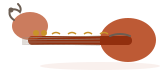
Carnatic
- Voice (the foundation of the tradition)
- Violin
- Veena
- Mridangam (percussion)
- Flute
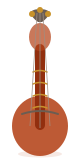
Hindustani
- Voice
- Sitar
- Tabla (percussion)
- Sarod
- Harmonium
Diaspora teacher availability: vocal teachers are the easiest to find in both traditions, in person and online. Carnatic violin and veena, and Hindustani tabla and harmonium, are reasonably well served — diaspora schools and online marketplaces like ipassio list them widely. Rarer instruments (sarod, flute specialists) usually mean going online. See how to find a local teacher and the platform comparison.
Age and starting point
A common pattern among teachers:
- Under 7: vocal first, in either tradition — most teachers recommend vocal basics even when an instrument is the long-term goal. Instruments follow at age 7–8.
- Ages 7–12: vocal remains the strongest foundation; for instrument-keen kids, Carnatic families usually start with violin or veena, Hindustani families with harmonium or tabla.
- Teens (13–18): can start an instrument directly — Carnatic: violin; Hindustani: harmonium or sitar.
- Adults: vocal is the most flexible and has the lowest equipment barrier; harmonium (Hindustani) or keyboard with Carnatic notation are accessible, portable instrument routes.
Want this mapped to your own family in two minutes? Take the Find Your Path quiz.
Does it matter which one you choose?
Honestly: less than parents fear. A heritage match helps because the music gets reinforced at home — grandparents, playlists, festival events all become part of the practice environment. But both traditions are complete, rigorous systems, and a student who thrives in either has gained the same core musicianship.
If your family is mixed or has no classical background in either tradition: either path works. The music playing in your home makes more difference than ancestry — pick the one the learner has already heard, and commit for a term. Switching later is possible but costs real time: repertoire, notation habits and ornament style are different enough that a switch restarts part of the journey. Pick one, give it a year, and reassess.